
What's holding back regenerative agriculture (and why should you care)?

Updated: 11 minutes ago

Cows are rough on the environment. They eat a lot, they wear down soil and methane comes out the other end. I have nothing against cows. As a member of a species not known for treading lightly, I’m in no position to lecture them. Still, think of what it takes to make a glass of milk. Before anything else, you have to make an entire 1,600 pound (725 kg) cow.¹ You feed it for a couple of years, water it, house it, keep it healthy, breed it, milk it and deal with what it leaves behind.
Now imagine being able to get a glass of milk without having to grow an entire cow first.
In November 2025, cafés in Tel Aviv started steaming milk that didn’t come from a cow. The milk, containing the same whey protein you get from cow’s milk, was grown in a factory fermentation tank. By January it was in supermarkets under the name The New Milk.² What wasn’t obvious to me was what any of this had to do with regenerative agriculture.
“Regenerative agriculture” was one of those phrases I’d heard often enough that I assumed I knew what it meant. My picture was simple. Manure goes back onto a field. Food scraps become compost. Yesterday’s waste helps grow tomorrow’s food.
Conventional food systems run mostly in one direction. We take resources from the ground, use them to grow and make food, eat the food and throw much of what remains away. Then we go back for more. Regeneration tries to change that. Water gets reused. Nutrients we would otherwise lose become inputs again. We get another use from what we already have.

I understood the idea. What I didn’t understand was what it would take to make a food system work that way. So my team and I took a closer look at nine linked value chains within regenerative food and agriculture: 118 segments, 534 subsegments, 1,010 technologies and hundreds of nontechnology factors standing between today and a regenerative future.
Precision fermentation was the first surprise. Several of the higher-priority bottlenecks emerging from our analysis were connected to it. What did fermentation tanks have to do with regenerative agriculture?
That’s why I started this article with cow-free milk. Cow-free milk can be made through a process called “precision fermentation,” which uses microorganisms, such as yeast, to produce specific ingredients or proteins inside large steel tanks. Nothing is being returned to a field. Done right, though, it could reduce how many resources the food system needed in the first place.
This helped me see the system differently. If the objective is a regenerative food system at scale, reducing the amount of new resources it requires can complement recirculating and restoring resources. The two aren’t the same, but they can reinforce each other: use fewer inputs and recycle/reuse more outputs.
At the scale of one small farm, this is relatively easy to picture. A cow eats forage grown nearby, its manure is loaded on a tractor and spread back onto a field. The farmer can control most of the loop and gets some efficiencies in the process.
Now try making this work for billions of people.
The manure may be hundreds of miles from the land that needs its nutrients. Food leftovers arrive mixed with packaging. Seedlings have to exist years before they are needed. Biological processes need industrial fermentation plants. Recovered phosphorus has to be made safe and moved back into agriculture. What one farmer could manage now stretches across farms, factories, waste streams, transportation networks and different companies.
No one controls all of those pieces. Regulators decide what can be used. Investors decide what gets funded. Some things take years to grow. Others require specialized facilities or people. Making the system work at that scale depends on people and businesses that may have little reason to think of themselves as part of the same system.
From lab-scale to industrial-scale.
We already know some of these new approaches can work. New Culture has made mozzarella using fermented casein, and Remilk has received clearances for its fermented dairy protein in Israel, the United States, Canada and Singapore.² ⁴
Whether making milk protein this way actually leaves us better off is another question. One peer-reviewed study modeled its carbon footprint at 5.5 to 17.6 tonnes of CO2 per tonne of protein, depending largely on the sources of sugar and electricity, compared with roughly 10 tonnes for protein extracted from milk.³ Removing the cow can make things better, or worse.
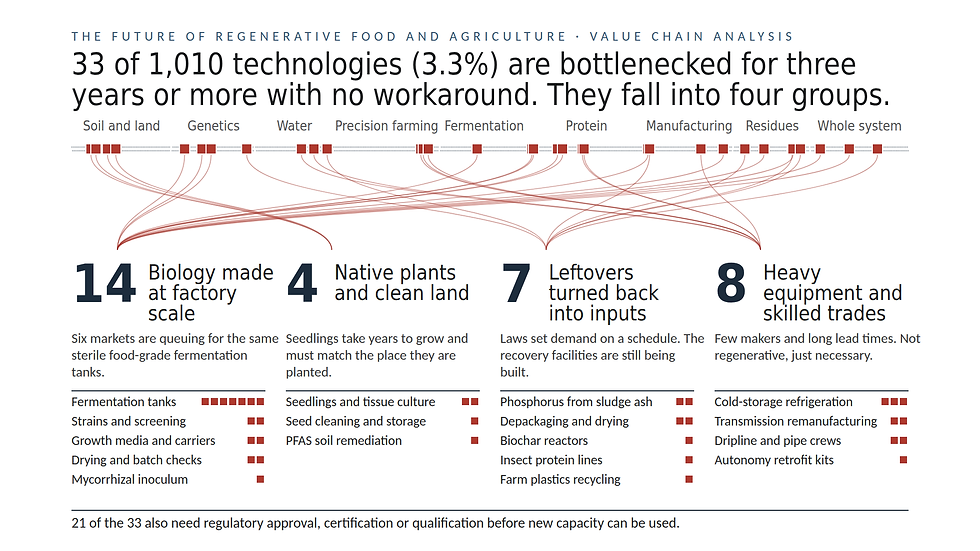
Then there’s the problem of making enough. Perfect Day is pursuing a fermentation facility in India, while Remilk postponed plans for what it had described as the world’s largest precision fermentation facility and shifted to contract manufacturers.⁵ ⁶ The same food-grade fermentation capacity is also needed by companies growing microbes for agriculture, turning food leftovers into feed protein and making egg protein. Six markets that look separate on an industry map can end up waiting for the same steel.

Of the 1,010 technologies we examined, only 33 emerged as persistent bottlenecks that we expect to remain constrained for more than three years with no clear workaround.
The good news is, markets are indeed starting to respond. For example, in July 2026, ADM and The EVERY Company announced commercial-scale production of fermented egg white protein in Iowa.⁷ Some bottlenecks can be relieved by building more capacity. Others take a lot more time.
What else rose toward the top
Once we mapped the value chains and began prioritizing the bottlenecks, some very different things rose toward the top:
Native seedlings. Restoring damaged land requires the right native plants, grown for where they’ll eventually be planted. If nursery capacity isn’t established early enough, money can’t buy that growing time back.
Phosphorus recovery. Phosphorus can be recovered from sewage and returned to farmland. Germany’s recovery requirements begin in 2029, but the necessary infrastructure is still being built.⁸ Switzerland faces a similar capacity problem.⁹
Certification and regulatory approval. Twenty-one of the 33 persistent technology bottlenecks also face gates such as certification, customer qualification or regulatory approval. New Culture could make its animal-free cheese, for example, but couldn’t sell it until the label was cleared.⁴
The people and equipment that make everything else work. Refrigeration technicians, qualified pipe crews, buried dripline, rebuilt transmissions and farm-equipment retrofit hardware also appeared among the bottlenecks. Irrigation needs pipe installed, new foods need cold storage and fermentation plants need people who can install, qualify and repair their equipment.
A nursery operator, refrigeration technician, fermentation engineer or pipe installer may never think of themselves as working in regenerative agriculture. Neither might someone financing a phosphorus recovery plant. Yet building this future at scale may depend on getting all of them to participate.
Regenerative agriculture faces a classic Innovator's Dilemma
Fonterra is a good example of a broader challenge in regenerative agriculture: getting incumbent companies to buy into a long-term regenerative future when they have strong near-term incentives to oppose it.
Fonterra, a roughly $4 billion New Zealand dairy cooperative, has spent the past two decades selling its farmer owners’ cow milk around the world. If cow-free dairy becomes successful enough, it could be game over for Fonterra and dairy companies like it. Seeing this possibility and wanting to get ahead of it, Fonterra helped launch and fund Vivici, a precision fermentation company that put fermented whey protein on the US market in 2024 and fermented lactoferrin in 2026.¹⁰
That puts Fonterra squarely in the dilemma Clayton Christensen spent much of his career articulating. The Innovator’s Dilemma isn’t that incumbents fail to see new technologies coming. It’s that, even when they see a disruptive technology on a collision course with their legacy business, they have powerful incentives to keep doing what they already do best. Their best customers, existing investments and economics create enormous near-term pressure to keep making and improving the products that sustain the business today. A disruptive alternative asks them to undermine something concrete and profitable now in exchange for the possibility of a larger market somewhere in an uncertain future.
Vivici faces the opposite incentives. It has no conventional dairy business to protect. If cow-free dairy eventually becomes good enough and economical enough to compete at scale, Vivici wins by helping make that happen.
Fonterra helped create and fund Vivici, but it doesn’t own the company. Its investment is a hedge, and a relatively small one compared with what’s at stake. Even if Vivici becomes a huge success and Fonterra someday makes $1 billion from its investment, that’s still a one-time gain set against a roughly $4 billion dairy business whose value depends on farmers continuing to sell cow milk. No plausible return on a minority investment replaces the business Fonterra stands to lose if cow-free dairy ultimately makes much of that milk unnecessary.
Fonterra is just one example of a much larger problem. Across the hundreds of technologies, businesses and other changes involved in moving toward regenerative agriculture, incumbents face versions of the same dilemma. Many control the capital, infrastructure, expertise, customers and market access needed to accelerate the transition while making very good businesses from the products and processes that transition could displace.
So their incentives aren’t neutral. Where regeneration threatens an incumbent’s existing business, that company has an economic incentive to slow, contain or stop the disruption, even if it also invests in the new technology to hedge its bets. Meanwhile, new entrants may have every incentive to push the transition forward but lack the resources to do it at scale.
That makes incentive alignment itself a bottleneck in regenerative agriculture. Getting from today’s food system to a regenerative one requires more than solving the technical bottlenecks. It requires companies across entire value chains to help build a long-term future that some of them, acting rationally on their near-term economics, have good reasons to resist.
So what’s holding regenerative agriculture back (and why should you care)?
There isn’t one answer. Sometimes we need a better technology. Sometimes the technology works, but there isn’t enough capacity. Sometimes the missing piece is a nursery, a phosphorus recovery plant, a technician or regulatory approval. Sometimes the people with the greatest ability to move the system forward have the least economic reason to do it.
Finding the bottlenecks matter. If the problem is fermentation capacity, another scientific breakthrough doesn’t solve it. If seedlings take years to grow, funding after a drought arrives doesn’t give you those years back. If the bottleneck is an incumbent’s economics, proving that a new technology works doesn’t change its incentives. Different bottlenecks require different solutions.
Why should any of us care? Food and agriculture aren’t somebody else’s problem. We participate in this system every day. We all eat. Just as healthcare eventually makes all of us patients, the food system makes all of us consumers of the land, water, nutrients, energy and other resources required to feed ourselves.
Regeneration is ultimately about whether we can keep feeding ourselves in a way that works better for us and the natural systems we depend on, both now and over the long term. It's also about the economics; the prices we pay, both on and off the human balance sheet. That means using fewer new resources where we can, recovering and reusing more of what would otherwise be lost and restoring more of what food production depends on.
Knowing the bottlenecks gives us somewhere to act. Scientists and engineers can see which problems still need breakthroughs and which no longer do. Policymakers can see where regulation, infrastructure, training or incentives could make a difference. Companies can see where scarce capabilities or collaboration matter. Investors can find essential, persistently constrained capabilities where solving a problem can create economic value while moving the larger system forward.
Moving toward a regenerative food system isn’t only a challenge for farmers, environmentalists or food companies. It is a series of specific problems spread across an economy that all of us rely on every day. Once we know which are actually holding the system back, we have a much better idea of what to work on, what to fund and where the fewest, most targeted efforts can have the biggest systemic impact.
Endnotes
Holstein Association USA, “History of the Holstein Breed,” accessed September 11, 2026. A mature Holstein cow weighs about 1,600 pounds. https://www.holsteinusa.com/holstein_breed/breedhistory.html
AgFunderNews, “‘New Milk’ Signals New Phase for Recombinant Dairy, Says Remilk,” November 10, 2025; Green Queen, “Remilk & Gad Dairies Roll Out Cow-Free Milk with Fermented Whey Protein,” November 11, 2025. Remilk received Israeli approval in 2023 and has clearances in the United States, Canada and Singapore.
Katri Behm et al., “Comparison of Carbon Footprint and Water Scarcity Footprint of Milk Protein Produced by Cellular Agriculture and the Dairy Industry,” The International Journal of Life Cycle Assessment 27 (2022): 1017-1034, https://doi.org/10.1007/s11367-022-02087-0. The study modeled beta-lactoglobulin production under different production conditions.
Food Dive, “New Culture Will Launch Animal-Free Mozzarella at Acclaimed LA Pizzeria,” May 9, 2023; FoodNavigator-USA, “New Culture Prepares to Launch Animal-Free Mozzarella to Market,” January 22, 2025; Food Business News, “New Culture Secures $5 Million in ‘Early Demand’ for Animal-Free Mozzarella,” March 21, 2025.
Green Queen, “Perfect Day Is Coming Out of ‘Incognito Mode’ With Its Animal-Free Whey,” August 18, 2026; AgFunderNews, “Perfect Day Says Gujarat Facility on Track for 2026 Start,” December 15, 2025.
Cultivated X, Remilk company page, reporting postponement of the planned Denmark facility; AgFunderNews, December 15, 2025, on the shift to co-manufacturers in North America and Asia.
ADM, “ADM, EVERY Company Partner to Deliver US-Based Commercial Scale Production of OvoPro Egg White Protein,” July 14, 2026.
German Environment Agency (Umweltbundesamt), Evaluierung verfügbarer Kapazitäten thermischer Klärschlammbehandlung sowie zur Phosphorrückgewinnung, Texte 56/2025, April 2025.
Swiss Federal Office for the Environment, “FAQs on Phosphorus Recycling.”
DairyReporter, “Animal-Free Dairy Round-Up: Vivici, TurtleTree and New Culture,” February 19, 2024; Nutrition Insight, “Vivici’s Precision Fermentation Lactoferrin Launches in US,” February 26, 2026.


